
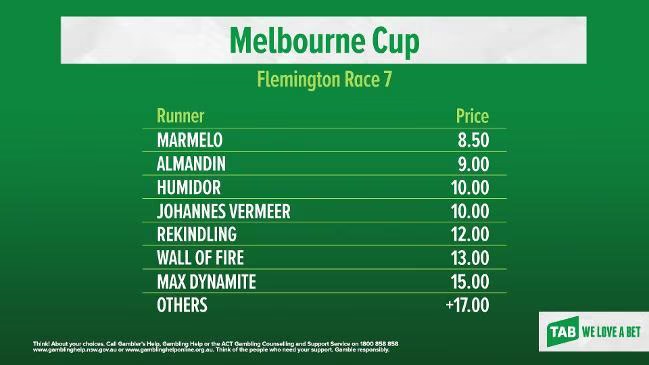
Understanding Melbourne Cup Odds: A Complete Guide
The Melbourne Cup is one of the most famous horse races in the world, held every year at Flemington Racecourse in Melbourne, Australia. Known as “the race that stops a nation,” it attracts international attention, elite horses, and massive public interest.
One of the most talked-about aspects of the race is odds. Even people who do not follow horse racing closely often hear discussions about favourites, long shots, and shifting prices before the race begins.
But what exactly do Melbourne Cup odds mean, how are they formed, and why do they change so often?
This guide explains everything in a simple, educational way.
What Are Melbourne Cup Odds?
In horse racing, odds represent probability and potential payout. They are a numerical expression of how likely a horse is believed to win the race.
In simple terms:
- Lower odds mean a horse is considered more likely to win.
- Higher odds mean a horse is considered less likely to win.
However, odds are not just predictions. They are also pricing tools used by bookmakers to balance risk and betting activity.
For example:
- A horse with low odds is called a favourite
- A horse with high odds is called an outsider or long shot
The Melbourne Cup, being a highly competitive race with 20+ horses, usually has a wide range of odds.
How Odds Are Calculated
Melbourne Cup odds are not randomly assigned. They are influenced by a combination of statistical analysis, expert judgment, and betting market activity.
RECOMMENDED
1. Horse performance history
Bookmakers look at:
- Past race results
- Distance performance (especially long-distance races)
- Finishing consistency
- Performance against strong competition
Horses that consistently perform well in high-level races tend to have lower odds.
2. Track conditions
Track surface plays a major role:
- Firm track = faster conditions
- Soft or heavy track = endurance-focused conditions
Some horses perform significantly better in certain conditions, and this affects their odds.
READ ALSO
3. Jockey and trainer reputation
Experienced jockeys and successful trainers influence confidence levels in a horse.
A well-known trainer or elite jockey can slightly shorten a horse’s odds due to perceived advantage.
4. Weight carried by the horse
In handicap races like the Melbourne Cup, horses carry different weights to balance competition.
- Heavier weight can slow a horse down
- Lighter weight can improve performance
This factor strongly influences odds calculations.
5. Market demand (betting activity)
One of the biggest influences on odds is public betting behaviour.
If many people place bets on a particular horse:
- Its odds shorten (become lower)
If fewer people support a horse:
- Its odds lengthen (become higher)
This creates a constantly moving market.
Why Melbourne Cup Odds Change
Unlike fixed predictions, odds change frequently before race day.
1. Public betting pressure
If large amounts of money are placed on one horse, bookmakers adjust odds to reduce their potential loss.
2. Injury or withdrawal news
If a strong horse:
- Gets injured
- Is scratched from the race
Then odds for other horses shift immediately.
3. Barrier draw results
The Melbourne Cup barrier draw (starting gate position) can affect race advantage.
- Inside barriers may offer tactical advantages
- Outside barriers may require more effort early in the race
This can impact market confidence.
4. Weather changes
Weather plays a big role in horse racing.
Rain can turn a dry track into a soft or heavy surface, changing which horses are favoured.
5. Late form analysis
As race day approaches, experts review:
- Final training sessions
- Trial runs
- Recent performance updates
These insights can influence market sentiment.
Favourite vs Outsider Explained
⭐ Favourites (low odds)
These horses are:
- Strong performers
- Backed by experts and bettors
- Consistent in major races
However, favourites do not always win, especially in long-distance races like the Melbourne Cup.
🌙 Outsiders (high odds)
These horses:
- Are considered less likely to win
- Often have inconsistent form
- May lack strong race history
But occasionally, outsiders surprise everyone and win, which is part of what makes the Melbourne Cup unpredictable.
Types of Odds Formats
In Australia, Melbourne Cup odds are commonly shown in decimal format.
Example:
- 2.50 odds → returns $2.50 for every $1 staked
- 10.00 odds → returns $10 for every $1 staked
Decimal odds are simple because:
Total return = stake × odds
How to Read Odds in Context
Understanding odds requires more than just numbers.
A horse with low odds is not guaranteed to win—it simply reflects:
- Higher public confidence
- Stronger performance history
- Market expectations
Similarly, high odds do not mean a horse has no chance—it just means expectations are lower.
Horse racing is unpredictable due to:
- race distance (3200m endurance test)
- large field sizes
- race-day conditions
Why Melbourne Cup Odds Attract So Much Attention
The Melbourne Cup is unique because:
- It is one of the richest races in Australia
- It features international competitors
- It has a large field (often 20+ horses)
- It is a handicap race, making outcomes less predictable
Because of this, odds become a major talking point in media coverage and public discussion.
Important Reality About Odds
It is important to understand:
- Odds are not guarantees
- Even strong favourites can lose
- Long shots sometimes win unexpectedly
Horse racing outcomes depend on many variables beyond statistics.
Summary
Melbourne Cup odds are a reflection of:
- Horse performance
- Race conditions
- Jockey/trainer reputation
- Public betting activity
- Market adjustments before race day
They are dynamic, constantly changing, and designed to reflect probability—not certainty.